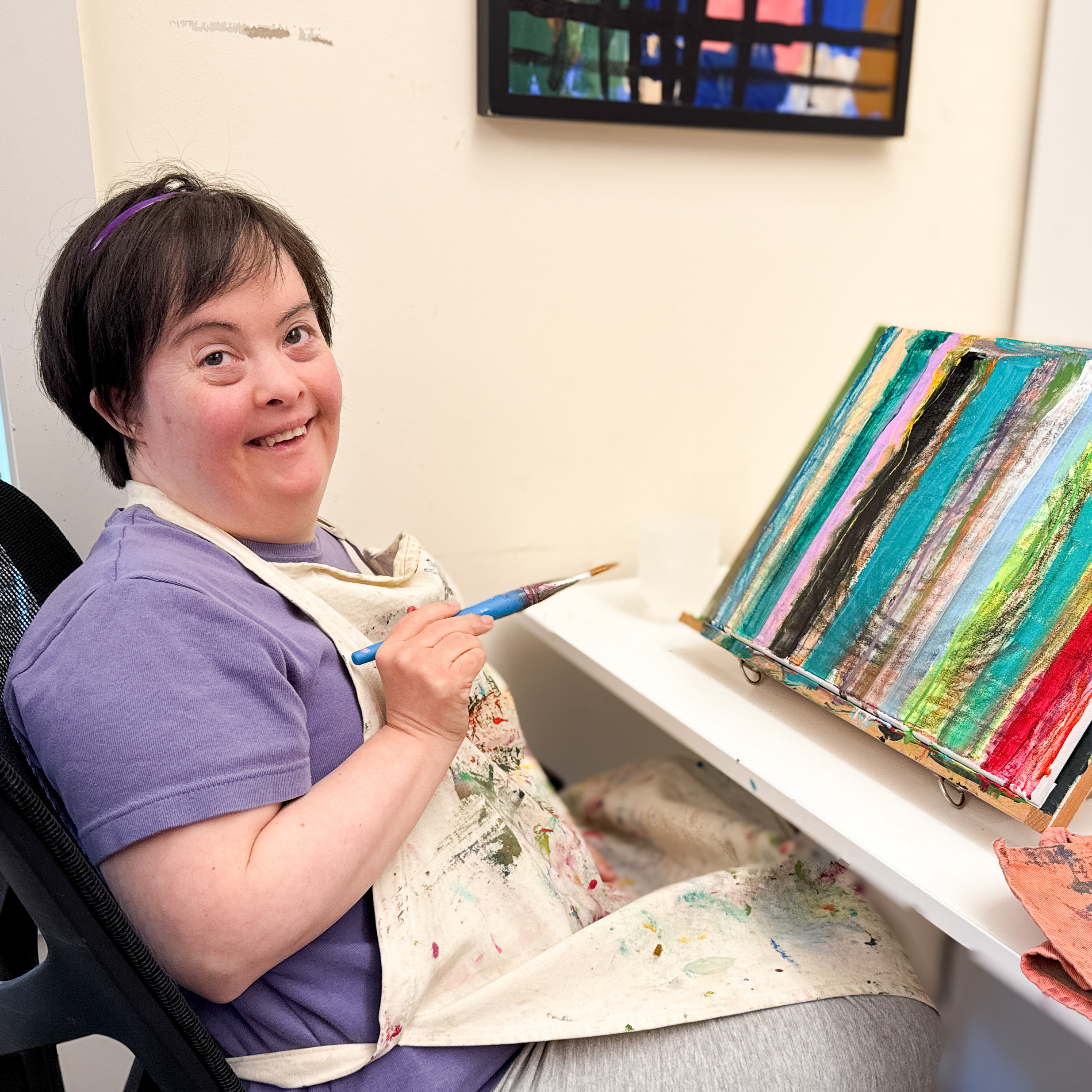
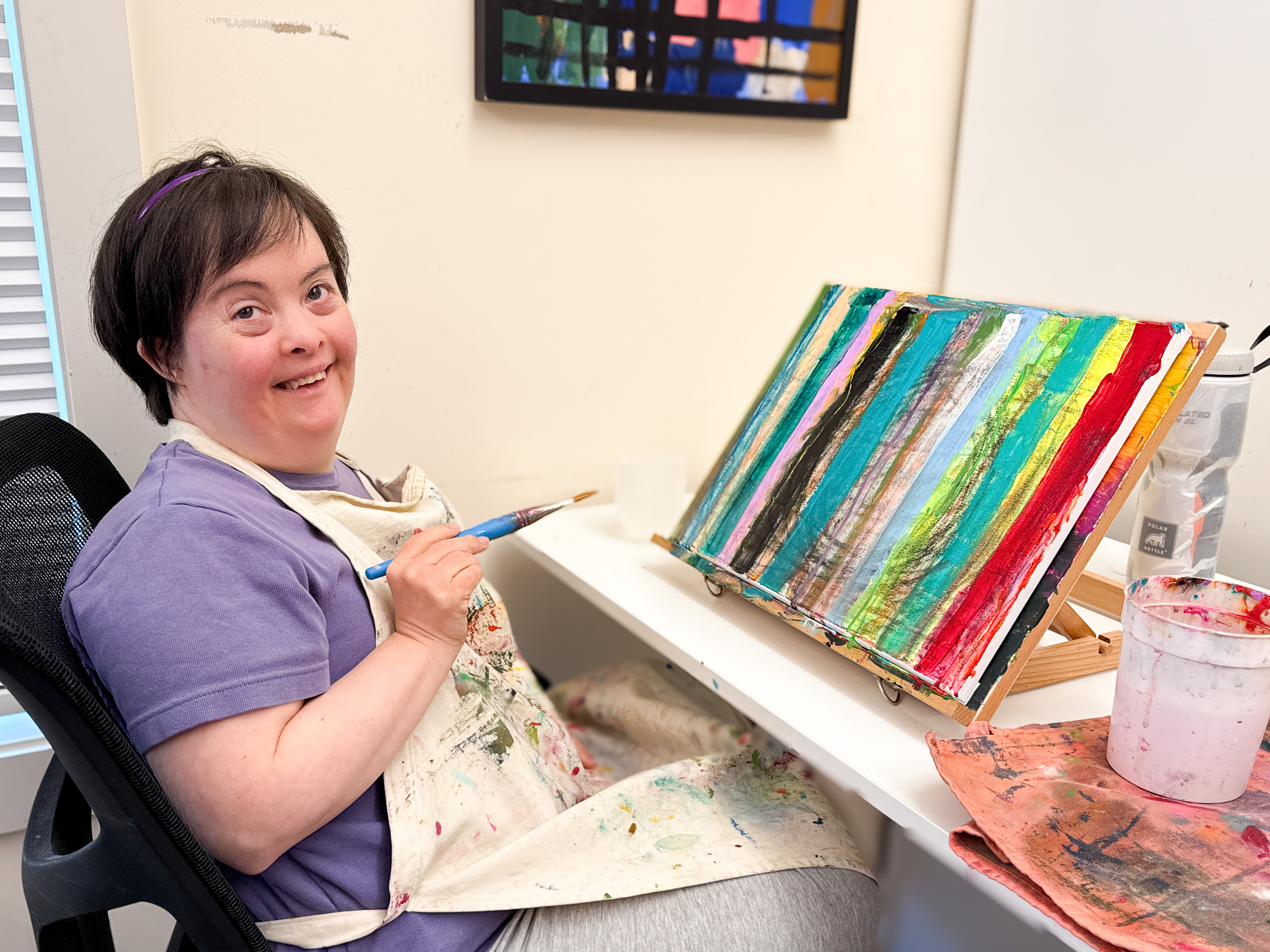
 CATA artist Sandra Caideco paints in her signature style.
Sunlight streams into CATA’s Supported Studio as CATA artist Sandra Caicedo dabs bright purple paint onto a canvas. Today she is expanding a drawing she made earlier in the year into a large-scale painting — a stunning composition of tight, nested blocks of color. Each week, Sandra attends CATA’s Supported Studio pilot program, where she is creating a series of vibrant, expressive paintings. This new program is designed for artists with disabilities who want to work independently on self-directed projects with the support of a Faculty Artist mentor.
“Sandra is a highly organized artist who likes to build a painting in sections,” says Lauren Levato Coyne, a CATA Resident Faculty Artist. “Each color is part of a language she’s developed in our Supported Studio that is consistent across all her work.”
Laurie Sunderland — who has been a CATA artist for over 20 years — also has a unique style that’s blossomed since she joined CATA’s Supported Studio. Laurie often draws inspiration from family photos to create dreamy narrative scenes. She has always used cheerful color palettes, but this year in the Supported Studio she’s developed a signature approach to figure drawing and storytelling that is totally her own. Her paintings “Two Ladies Enjoying Their Day” and “Fall” will be featured in CATA’s Annual Art Show this summer.
“Supported Studio allows artists like Laurie and Sandra to dig deeper into their talents and hone their individual style,” says Kara Smith, CATA Program Director. “The program is intentionally flexible and adaptive so artists can try new things. When an artist can take risks, that’s when they really flourish.”
 Laurie Sunderland works in the Supported Studio. “I like to paint from my memories,” says Laurie. “I use my imagination in my art.”
Adaptive Art-Making
Artworks in CATA’s Annual Art Show were created by artists who explore all kinds of adaptive art-making across CATA’s programs and workshops. “CATA’s innovative approach to adaptive art-making looks different for everyone,” says Kara. “Our Faculty Artists work closely with each artist to provide tailored materials, responsive environments, and adaptive tools that ensure everyone can express their unique vision.”
At BFAIR in North Adams, CATA artist Anthony Pansecchi, who is blind, uses a braille paint palette to mix his favorite colors, and a tactile tool to place the paint on his canvas, applying the edge to make a sharp line down the center.
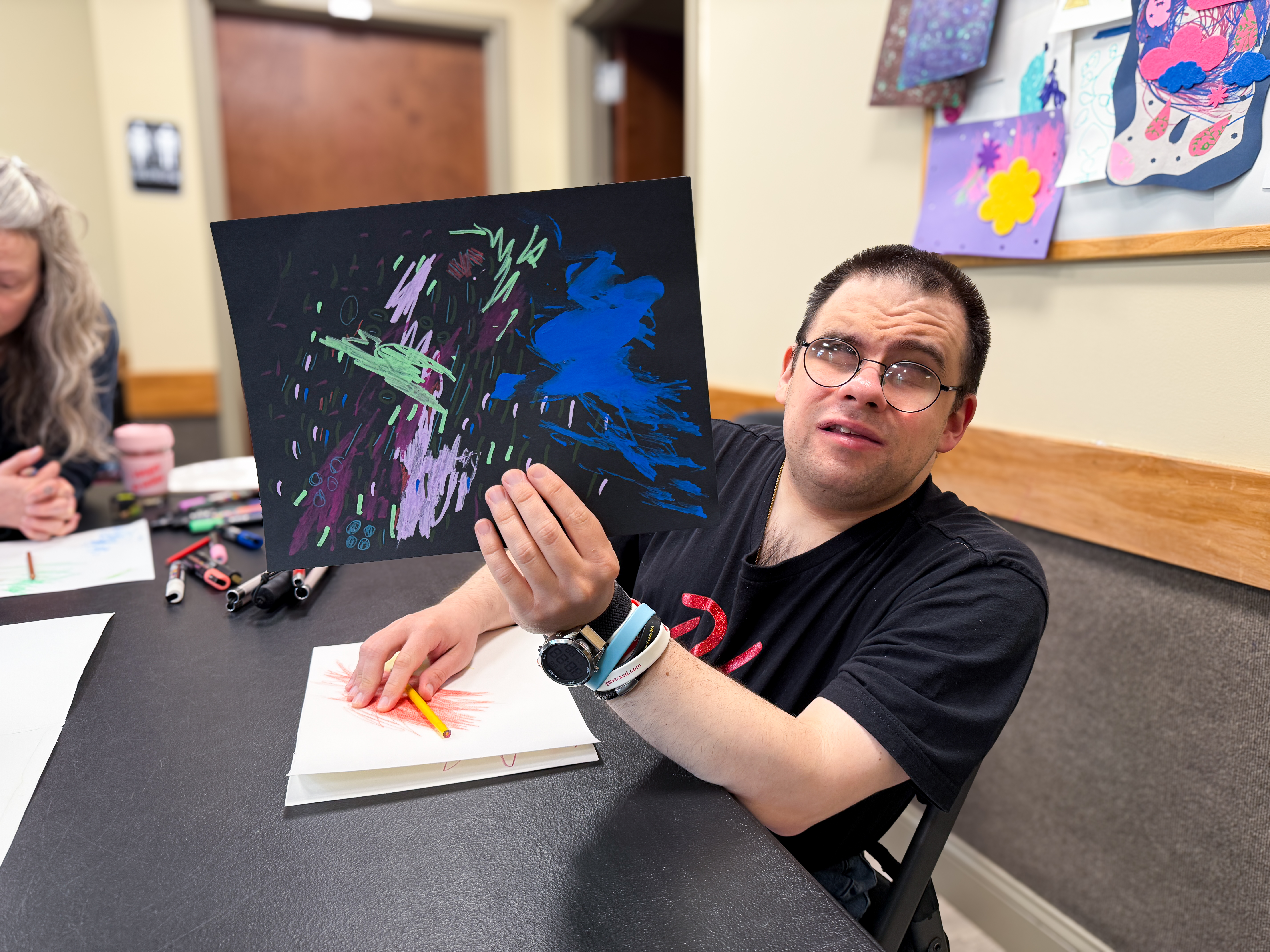 Anthony Pansecchi shows his piece “Fireworks”
At Berkshire County Arc’s Center for Development in Lee, CATA artist Jeff Hitchcock creates a beautiful floral landscape using a laser pointer to direct the movement of the brush across the canvas; this process was honed by CATA based on a technique called Artistic Realization Technologies (A.R.T), originally developed by the artist Tim Lefens, designed to make painting accessible for people with profound physical disabilities.
 Jeff Hitchcock with his vibrant work “Jeff’s Variegated Garden”
“A key part of our Strategic Plan is developing new programs for CATA artists to go deeper into their talents and explore their creative passions,” says Margaret Keller, CATA Executive Director. “We’re launching innovative pilot programs like our Supported Studio and new adaptive art-making workshops where CATA artists are learning new skills and bringing their creative ideas to life.”
In CATA’s studio workshop “Creating Comics,” CATA Resident Faculty Artist Adam Gudeon works with each artist, adapting methods of visual storytelling that help bring everyone’s vision to life. All year CATA artist Max Schweizer has been working prolifically on an animated series with a huge cast of invented characters and intricate plots. He draws his characters on paper and then chooses the perfect backdrop — a photo of outer space sets the stage for a piece titled “Space Station Fight.” Max moves his characters around the backdrop while Adam takes pictures with an animation app — when Max calls out “Cut!”, he’s ready to approve the final piece.
 Max Schweizer arranges the characters in his stop-motion animation alongside CATA Resident Faculty Adam Gudeon.
Thank you to our donors who are making CATA’s Supported Studio program possible, including Stephanie Gittleman and Carol & Michael Riordan. Interested in supporting a CATA program or initiative? Contact us at 413-528-5485 to learn how you can support this vital work.
PS: Visit our Annual Art Show this summer to see the work of CATA artists in person. You can also explore CATA art right now on the Bloomberg Connects app! Experience CATA art like never before, with video interviews, immersive audio guides, behind-the-scenes highlights, and more. Download the free app to get mobile access to CATA’s Annual Art Show I Am A Part of Art, or explore it in your browser.